How a “Normal” Galaxy Can Reveal the Universe’s Evolution Secrets
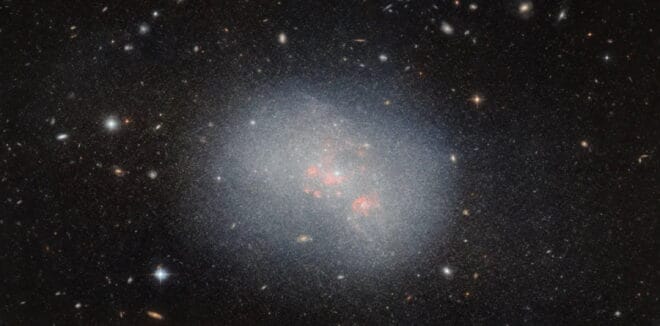
The NASA and the European Space Agency recently showcased an image captured by the Hubble Telescope of NGC 5238, a dwarf irregular galaxy in the Canes Venatici constellation, located 14.5 million light-years away.
Despite its seemingly ordinary appearance, NGC 5238’s intricate structure demands closer examination.
NGC 5238, a Galaxy Full of Mysteries
The stellar configuration in NGC 5238 hints at a tumultuous past. The galaxy’s “star population” may have been altered by the “consumption” of another galaxy. The presence of striking globular clusters—dense, bright star groups within and around the galaxy—as noted by NASA, supports this theory.
This galactic encounter is thought to have occurred about a billion years ago. Although NGC 5238 does not appear to be near another galaxy, astronomers believe it likely merged with a smaller satellite galaxy. The investigation is just beginning, aiming to identify distinct star groups within the galaxy to confirm this merger.
Decoding the Past to Understand Universe Evolution
NASA emphasizes the significance of this research: a dwarf irregular galaxy merging with a smaller satellite could mirror early universe galaxy formation. Hubble’s data on NGC 5238 could thus offer crucial insights into fundamental theories about the universe’s evolution. By delving into these findings, astronomers hope to eventually uncover a “festival of star formations” triggered by a potential merger.