World’s Oldest Painting Uncovered in Indonesia
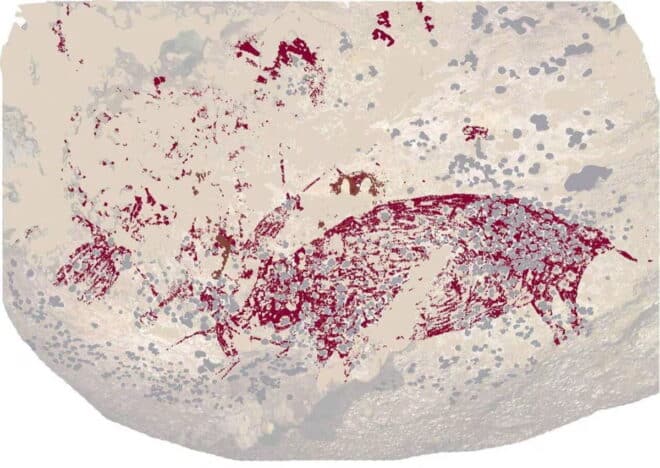
An innovatively dated 51,200-year-old cave painting offers a fresh perspective on early humans.
In an Indonesian cave, a cave painting over 51,200 years old has been uncovered, making it the oldest known figurative artwork to date. The painting features a red pig surrounded by human figures, demonstrating a simplicity and narrative power surpassing the more recent Lascaux or Chauvet frescoes, which date from 19,000 to 36,000 years ago.
A 51,200-Year-Old Cave Painting Dated Innovatively
Researchers have employed groundbreaking technology to precisely date this artwork for the first time. They used laser dating techniques and software to create a “map” of the rock sample, focusing on the mineral layers accumulated over time rather than the painting itself. This method pinpointed the layer closest to the painting, establishing its minimum age. This technology also clarified the age of another find by the same team: a hunting scene at least 48,000 years old.
A New Perspective on Early Humans
According to Maxime Aubert, co-author of the study, this groundbreaking artwork was likely created by groups migrating from Southeast Asia to Australia around 65,000 years ago. “It’s probably just a matter of time before we find older samples,” the archaeologist believes. Beyond its age, this fresco challenges our understanding of Homo sapiens’ cognitive evolution. Previously, the earliest known humanistic artworks were simple lines and patterns in ochre, dated to 100,000 years ago from South Africa. The narrative sophistication of the Indonesian painting represents a significant leap.
Until now, it was believed that the first narratives emerged in Western Europe. Consider the 40,000-year-old ivory sculpture of a lion-headed man found in Germany. However, this Indonesian discovery “overturns” our approach to the origins of figurative art. While the findings of this study will undoubtedly require further confirmation, they suggest an earlier—and more distant—birth of figurative art than previously believed.