Understanding the New Challenges of Moore’s Law
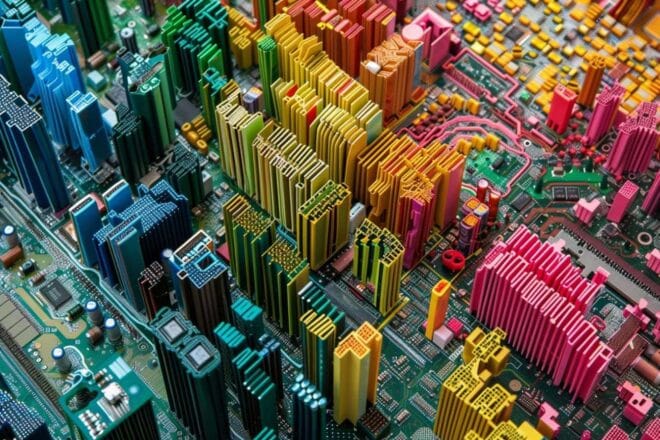
Explore how the "golden rule" of transistor density and the surge in AI architectures continue to drive economic and technological innovation.
A Fresh Look at Technological Progress
In an era of staggering increases in computational power, humanity’s capacity has grown exponentially, independent of economic conditions. This trend, which predates Gordon Moore’s 1965 observation within the fledgling semiconductor industry, reflects a long-term trajectory.
Illustrative image: Moore’s Law
Moore’s Law in the Era of Integrated Circuits
Moore’s Law isn’t just about predicting transistor density; it symbolizes technological advancement. Today, technology consumers focus on “computational speed and data storage density,” which underscores the transition to various integrated circuit architectures, from GPUs to ASICs, including NVIDIA Hopper.
From an Economic Perspective
Moore’s Law is not just external to the economy; it’s a growth driver. Its impact now extends beyond traditional sectors like electronics, communications, and computers into drug discovery, biotechnology, bioinformatics, and more.
Moore’s Law has catalyzed (and continues to catalyze) the emergence of new industries reliant on continual improvements in computational power and data storage density.
The Future of Moore’s Law
As observed, Moore’s Law is likely to continue with the same consistency observed over the past 128 years. Every sector on our planet will increasingly become information-centric. Companies will need to leverage optimized information use to stand out, making Moore’s Law more relevant than ever, despite being over half a century old.