Europe Sets New Standards for Sustainable Smartphones Starting in 2025
Beginning in 2025, Europe will implement new regulations aimed at promoting sustainability in the smartphone industry. These forthcoming rules are set to reshape manufacturing standards and encourage longer-lasting devices for consumers across the continent.
Tl;dr
- New EU regulations for smartphones/tablets start June 2025.
- Focus on durability, repairability, and energy labeling.
- Expected savings: €20 billion, 14 TWh energy yearly.
A Profound Transformation for Europe’s Digital Device Market
Beginning June 20, 2025, the European Union will enact a sweeping regulatory shift impacting smartphones, tablets, and other mobile devices. This new legislation — formalized through regulations n°2023/1670 and n°2023/1669 — aims to redefine industry standards. The rules specifically target products sold within the EU, though certain categories such as computer-tablets, flexible-screen devices, or models designed for secure communication remain outside its scope.
This ambitious push represents not just a technical adjustment but a strategic evolution in how we interact with everyday technology. Manufacturers will soon be obliged to display clear information regarding each product’s environmental performance, shifting both market practices and consumer expectations toward sustainability.
Pillars of Durability and Transparency
At the heart of the reform lie three key priorities: **durability**, **repairability**, and transparent communication. The measures are practical and far-reaching. For instance:
- Batteries must last at least 800 full cycles while retaining 80% capacity.
- Essential spare parts must be available for seven years post-sale.
- Software updates are mandated for five years after market launch.
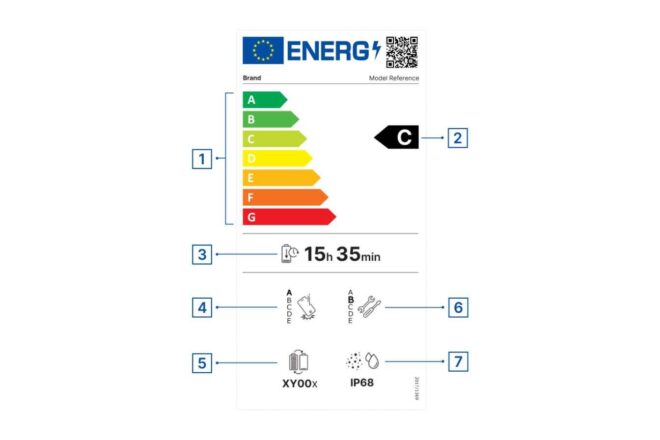
Moreover, an innovative European energy label will now inform consumers about each device’s energy efficiency, dust- and water-resistance, drop resistance, and an official repairability score. Shoppers will be able to access detailed product data by scanning a QR code linked to the EPREL database — a first for this market segment.
The Scale of Consumption — And Its Silent Impact
Let’s put this into perspective: back in 2020, roughly 687 million phones and tablets were active across the EU27 — an average of 1.5 devices per individual. Of these, smartphones represented over half, with tablets making up nearly a fifth. Consider also that wireless phones averaged just under ten minutes of daily call time yet spent thousands of hours per year on standby across Europe as a whole.
Chargers added to this silent consumption: typically connected for over two hours in active use, close to ten hours in trickle charge mode, and unplugged only briefly during a typical day.
Tangible Gains: Energy Savings and Economic Benefits
The projected outcomes are compelling. Official estimates suggest that by 2030 these measures could save as much as 14 terawatt-hours (TWh) of primary energy annually. That figure amounts to one-third of today’s device-related energy usage in Europe. On the economic front, households stand to gain significantly: anticipated savings reach around €20 billion in acquisition costs, or about €98 per household thanks to less frequent device replacement.
More than mere numbers, these changes also mean substantial reductions in greenhouse gas emissions and more prudent use of critical resources. By extending product lifespans — and making repairs easier — the regulation addresses environmental priorities while easing economic pressures on consumers.
In sum, this legislative overhaul signals nothing short of a turning point for Europe’s digital ecosystem: a decisive move toward greater responsibility — by both producers and consumers — in our increasingly connected lives.