Comet C/2025 R2: When and How to See It in France
ADN
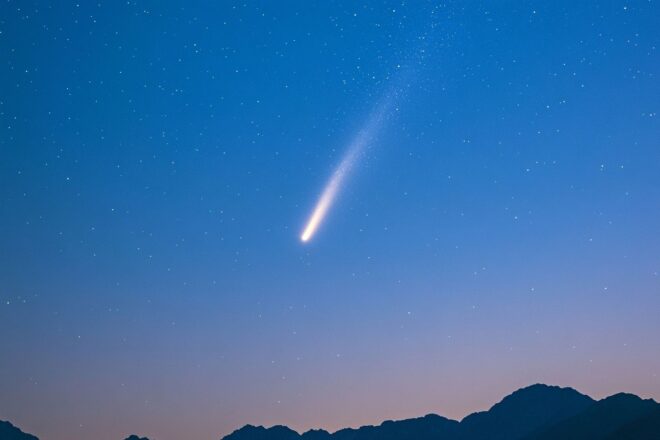
A striking comet known as C/2025 R2, notable for its impressive tail, is set to become visible from France. Astronomers have identified specific dates when the phenomenon will be observable, sparking anticipation among skywatchers nationwide.
TL;DR
- Rare comet C/2025 R2 (SWAN) visible soon.
- Best viewing after October 10 in southwest sky.
- Visibility and brightness may change unpredictably.
An Elusive Visitor Illuminates the Night Sky
Excitement is growing among astronomers and skywatchers as the rare comet C/2025 R2 (SWAN) prepares to make a notable appearance in the northern hemisphere. This celestial body, identified thanks to the SWAN instrument aboard the SOHO satellite, has captured attention with its swift journey across space and a vibrant blue tail stretching tens of thousands of kilometers.
Discovered almost by chance, this comet has quickly become the subject of both intrigue and anticipation within the astronomical community. As Nicolas Biver, an astrophysicist at the Paris Observatory, told colleagues at directs.fr, it has been quite some time since a comet of such brightness was observed—making this event all the more compelling.
The Art of Spotting C/2025 R2: Preparation Is Key
As this unique object draws nearer, observers are advised to prepare thoughtfully for its arrival. The most favorable window for viewing will open just after October 10, when the full moon recedes and the sky darkens sufficiently. For optimal results, direct your gaze toward the southwestern horizon shortly after nightfall. An easy technique: hold your fist parallel to the horizon—about ten degrees up marks where you should look for the comet’s fleeting glow.
Several factors explain this approach:
- Magnitude: The comet’s expected brightness ranges from 6 to 7, which may require binoculars if it dims beyond naked-eye visibility.
- Light pollution: Urban dwellers should seek darker areas away from city lights for a clearer view.
- Timing: Maximum proximity occurs on October 20, when C/2025 R2 will be approximately 0.34 astronomical units—nearly 50 million kilometers—from Earth.
A Story of Unpredictability: Comets Never Cease to Surprise
Comets have a reputation for defying forecasts, and this one is no exception. According to Nicolas Biver, “with comets, nothing is ever certain.” Unpredictable outbursts can occur when these predominantly gaseous bodies suddenly expel material, temporarily amplifying their brilliance. While these surprises make precise predictions difficult, they also add a sense of drama that only enhances public fascination.
A Celestial Event Worth Marking on Your Calendar
For those eager not to miss this rare spectacle, digital tools such as Star Walk can help pinpoint the comet’s path each evening. As autumn nights grow longer and cooler, patience—and warm clothing—will serve dedicated observers well. Ultimately, phenomena like C/2025 R2 remind us how fleeting and unpredictable cosmic wonders can be—a reason, perhaps, to pause and look up as night falls this October.