Lost Microcontinent Discovered Between Greenland and Canada: A Birth That Never Was!
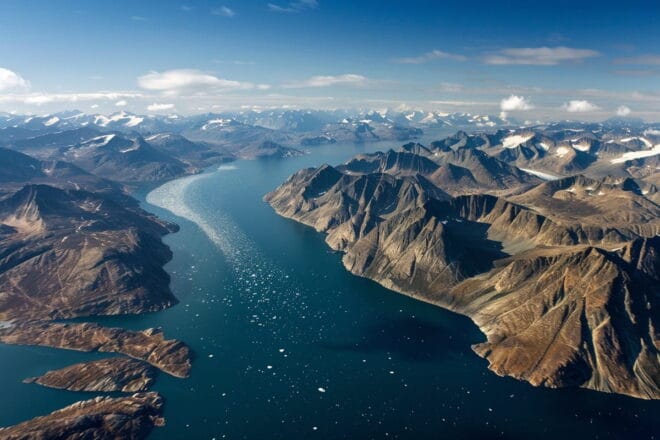
The current layout of our world maps results from tectonic movements, yet many details are still mysterious. For instance, researchers recently identified a missed microcontinent while investigating how the Davis Strait, which divides Canada and Greenland, formed.
Separated Continents and a Geological Mystery
About 100 million years ago, Earth’s landscape looked drastically different from today’s. The pieces of our modern tectonic puzzle were far from being put together, and the supercontinent Pangea was in its final stages of fragmentation. During this tumultuous period, the Atlantic Ocean began to form, marking the initial separation of Africa and North America.
Greenland and Canada, meanwhile, started stretching and thinning at several points in their crust, which eventually led to the creation of the Davis Strait. This strait, still poorly understood, connects the Labrador Sea to Baffin Bay.
A Puzzling Tectonic Jigsaw
The exact formation of the Davis Strait between 61 and 33 million years ago remains “very poorly understood”, a major anomaly in tectonic models due to a significant chunk of continental crust at its center. However, recent research published in Gondwana Research is shedding light on how this strait may have formed.
The Birth of a Proto-Microcontinent
The stretching of continental crust between Greenland and Canada is believed to have started 118 million years ago, at the end of the Cretaceous period, leading to the crust’s fracturing and the commencement of oceanic accretion in the Labrador Sea and Baffin Bay around 61 million years ago.
At the heart of the strait, a fragment of Greenland’s continental crust began to detach, potentially forming a microcontinent if conditions had persisted. However, a massive reorganization of tectonic plates led to a shift in the accretion direction, halting the evolution of the continental block and turning it into what is now referred to as a “proto-microcontinent”—a piece of land stuck between Canada and Greenland.
An Underlying Mystery
Surprisingly, despite clear geological evidence, this so-called proto-microcontinent is entirely submerged under the waters of the Davis Strait, with a thickness of only 19 to 24 kilometers, preventing it from forming an island. These new findings provide a deeper understanding of microcontinent formation and demonstrate the potential significance of shifts in tectonic plate movement.