NASA and European Space Agency Join Forces to Protect Earth from Asteroids
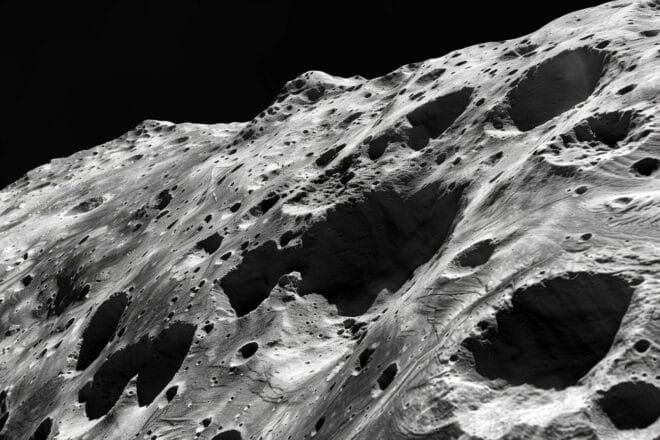
Today, the Hera mission is set to launch to assess the outcomes of the DART mission, which aimed to divert an asteroid, raising the question of its success.
The Hera Mission: A Giant Leap for Planetary Defense
Stepping straight out of a sci-fi scenario, the European Space Agency’s (ESA) Hera mission is set to launch on Monday, October 7, 2024. Its purpose? To assess the outcomes of the Dart mission, a bold initiative aimed at altering an asteroid’s path.
Overview of the Dart Mission
In 2022, NASA embarked on the Dart mission, a pioneering experiment in “planetary defense”. The goal was to change the trajectory of Dimorphos, an asteroid about 160 meters in diameter, to prepare for potential future threats.
The Dart spacecraft deliberately crashed into Dimorphos, shortening its orbit by 33 minutes. However, the impact’s effect on the asteroid’s internal structure remains unknown.
Following its collision with a NASA spacecraft aimed at diverting its path, the asteroid Dimorphos will now be scrutinized by the European probe Hera, launching this Monday #AFP
➡️ https://t.co/RramPEEhkJ pic.twitter.com/qw09HaKHe1
— Agence France-Presse (@afpfr) October 7, 2024
The Hera Mission: Unraveling the Mystery of Dimorphos
The Hera mission seeks to fill these knowledge gaps. “While it’s one of the least probable natural risks, we have the capability to take protective actions,” states Patrick Michel, the mission’s lead scientist.
Using two nanosatellites, Juventas and Milani, Hera will closely examine the asteroid’s composition and structure. Juventas aims to land on Dimorphos and measure its gravitational field, while Milani will analyze its composition.
A Significant Challenge for the Hera Mission
Nevertheless, the Hera mission faces challenges. A recent anomaly detected in SpaceX’s launcher could delay the probe’s launch. Despite this, ESA remains hopeful for clearance from U.S. authorities by Sunday.
If all goes according to plan, Hera will reach Dimorphos in December 2026 for an initial six-month study. Post-mission, the probe may end similarly to Rosetta, which explored the comet Churyumov-Gerasimenko from 2014 to 2016, by delicately landing on Dimorphos or Didymos.