Podcast: From PDA to Smartphone – The Palm Story
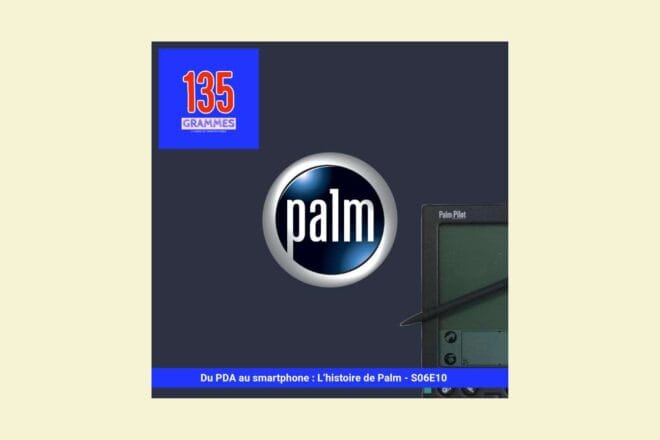
Long before the iPhone, Handspring and Palm laid the groundwork for the modern smartphone, pioneering a journey filled with brilliant ideas, industrial challenges, and a lasting technological legacy.
Birth of a Visionary
Join us on a fascinating technological odyssey: the story of Handspring, a pioneering startup that reimagined the telephone long before Apple’s iPhone. Handspring envisioned technology as an integral part of our daily lives, going beyond a mere communication tool.
Their overflowing promises were evident in the Palm Pilot, an innovative product by Handspring. Jeff Hawkins, the creator of the Palm Pilot, truly embodied the visionary approach of the startup. His big idea? “Validate a concept before heavily investing in it”. He crafted a wooden block to the dimensions of the intended device, added a wooden stylus, and attached printed visuals that simulated the screens. For weeks, he carried this mock-up, tapping on its imaginary screen to test essential functionalities like address books, calendars, memos, and task lists. This approach not only inspired but continues to shape the design of modern devices.
Illustrative Image. 01 Palm
Technological Revolution and Challenges
The PalmPilot was the first consumer product to feature a non-removable lithium-ion battery, a bold move at the time. Then came the Palm V, pushing innovation further with no visible screws, everything glued together—a radical idea that sparked debates over durability concerns. However, Hawkins, with his engineering acumen, overcame these technical challenges, creating one of the most refined designs on the market.
The PalmPilot 1000 became the first mainstream Personal Digital Assistant (PDA), capturing the market with features like a stylus-driven address book, calendar, task list, and digital memos—a genuine pocket organizer that was simple and effective. It sold over a million units in 1998, overwhelmingly outperforming Apple’s Newton, which launched in 1993 with only 80,000 sales. Clearly, Palm had tapped into something others had missed.
Palm overcame the skepticism of an industry by laying the groundwork for the modern smartphone with the Treo 180, which combined a mobile phone and a PDA. Less than a decade later, however, the company faced unity problems after splitting into two separate entities, weakening their position in an increasingly competitive market.
Illustrative Image. 02 Palm
WebOs: A System Ahead of Its Time
Against all odds, Palm made a strong comeback with the Palm Pre and its new operating system, webOS. It was innovative for its:
– Smooth multitasking
– Innovative touch gestures
– Advanced cloud integration
It also introduced Synergy, merging all your data into one place. Gmail, Yahoo!, Facebook, LinkedIn, Outlook—all your contacts consolidated into a single list. No more juggling multiple apps: webOS handled it all. At the time, this was revolutionary. Today, it’s standard practice as our smartphones automatically sync our contacts and calendars through the cloud. But Palm did it first. Despite this groundbreaking feature, Palm faced criticism over privacy issues when a Debian developer discovered that the Palm Pre regularly sent user data to Palm, including:
– User’s GPS data,
– History of apps used and their usage duration,
– Automatic daily information transmission.
A Precursor to App Stores
The PalmPilot also paved the way for another key concept: third-party applications. While there wasn’t an App Store yet, it fostered an ecosystem where developers could offer their apps, downloadable on PCs and installable via synchronization—a model that, years later, would become a cornerstone of smartphone success.
webOS was so innovative that it influenced the interface of modern smartphones… and was later adopted by LG for its connected TVs!
The Downfall of Palm
Palm’s story illustrates that innovation without solid and consistent execution is doomed to failure: “Despite its forward-thinking ideas, the Palm Pre was hindered by inadequate finishing”. The iPhone and Android smartphones, offering far superior build quality, ultimately sealed Palm’s fate. Despite a positive reception, the Palm Pre couldn’t reverse the trend.
The Competitors
To understand the impact of Palm and its innovations, it’s essential to consider the context of the era’s PDAs. While the Palm Pilot made history, it wasn’t the only player. Here’s the most iconic competitor, Apple’s Newton MessagePad launched in 1993 with ambitious vision. The device featured impressive functionalities for its time:
– Handwriting recognition,
– Advanced note-taking,
– Computer synchronization.
Illustrative Image. 03 Palm
Despite its futuristic vision, the Newton suffered from several shortcomings: a high price, limited performance, and notably, capricious handwriting recognition that became the butt of jokes, including in popular culture (hello, The Simpsons!). The result was a commercially mixed success but a cult favorite among tech enthusiasts.
The Legacy of Palm
Ironically, this visionary company, which missed the smartphone curve, left an undeniable technological legacy. The moral of its story is the importance of timing and perfection in execution. But it also shows that an apparent failure can hide a lasting, beneficial legacy, because “Palm is more than a failure; it’s a vision ahead of its time”.
More in the Podcast
The 135 Grammes Podcast is Available on Platforms:
– Apple
– Podmust
– Deezer
– Spotify
– Amazon