Skyrmions: The Key to Future Computers?
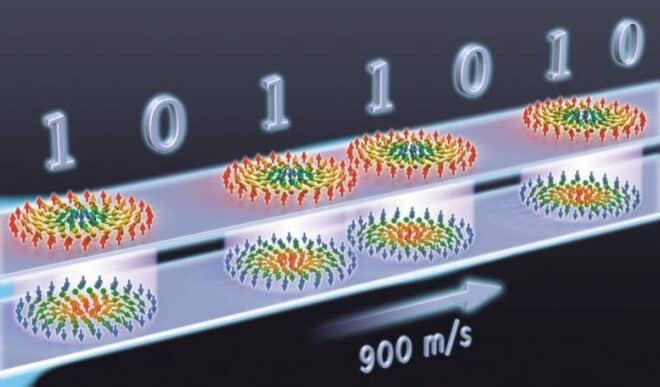
We aim to reduce computer size and energy use by exploring magnetic structures that act like particles in specific materials. An international team recently set a new speed record for moving these quasi-magnetic particles.
A Revolutionary Discovery in Computing
In 2009, German researchers from the University of Cologne and Technische Universität München (TUM) in Munich unveiled the existence of magnetic skyrmion crystals. Until then, the term might have been familiar only to science fiction readers. Today, this discovery could transform the computing world.
What are Skyrmions?
Skyrmions can be described as “magnetic nanobubbles” in condensed matter physics, originating from the theory of magnetic materials. Initially proposed to explain the existence of elementary particles like the proton, skyrmions are now at the forefront of technological advances.
A Revolution in Information Technology
An international research team, led by scientists from CNRS, recently found that skyrmions could be moved using an electric current in certain magnetic materials at record speeds of up to 900 m/s. Their findings, published in the journal Science, suggest groundbreaking potential.
These magnetic nanobubbles could lead to faster computers, reduced energy consumption, and miniaturized memory. Skyrmions could not only carry bits of information but also participate in operations for processing them with logic gates.
A More Efficient Future
In a magnetic environment, atoms act like tiny magnets. Magnetic environments can carry magnetized areas in various directions. A cluster of atoms aligned in the same direction forms a magnetized zone that can store information. Skyrmions, acting similarly, can form with as few as ten atoms, compared to a million in a standard hard drive. The future of computing could hinge on just ten atoms, potentially drastically reducing the size of magnetic memories and radically changing our technologies.