Star 2,600 Light Years Away Set to Become the Brightest
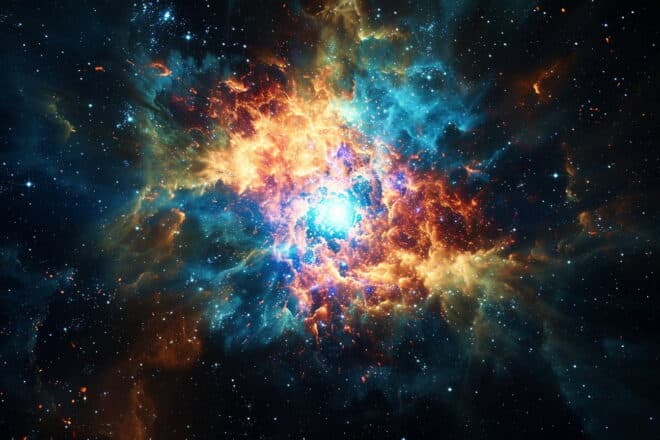
Get ready for a rare celestial event: a star hidden for decades will soon illuminate our summer nights and be visible with the naked eye. This unique cosmic phenomenon won't occur again until 2104.
Anticipated Celestial Explosion
For nearly 80 years, astronomers globally have been eagerly awaiting a dazzling event at the edge of space: the explosion of the binary star T Coronae Borealis (T CrB).
Expected between March and September 2024, this cosmic spectacle promises to be a stellar fireworks show.
T Coronae Borealis, a Recurrent Nova
What sets T Coronae Borealis apart? It is a recurrent nova, which undergoes cyclical explosions every few decades. Among the Milky Way’s 200 to 400 billion stars, only ten such novae are known.
Furthermore, T Coronae Borealis is showing signs “similar to those before its explosion in 1946,” says Sumner Starrfield, a professor at Arizona State University.
🌌 Around the world, astronomers, both professional and amateur, are intently observing T Coronae Borealis – a binary system approximately 3,000 light-years from Earth – as they anticipate a nova event bright enough to be seen with the naked eye from Earth.
MORE HERE >> https://t.co/HgONmjpy9B pic.twitter.com/L54ZDFmFWA
— NASA Marshall (@NASA_Marshall) June 6, 2024
Golden Hour of the Starry Sky
The nova explosion phenomenon, as seen in T Coronae Borealis, results from the interaction between two celestial bodies—a white dwarf and a former red giant. When the white dwarf’s temperature surpasses 10 million degrees Celsius, hydrogen ignites, triggering a cascade of thermonuclear reactions.
At its peak, the brightness of T Coronae Borealis could rival the North Star, becoming the brightest point in the sky. This fleeting celestial event will unfold in the constellation of Corona Borealis.
A Brief but Brilliant Show
However, those wishing to witness this unique event with the naked eye should not delay. Bradley Schaefer, professor emeritus at Louisiana State University advises, “It’s brief, the peak brightness will last only a few hours before it begins to fade quickly.” After just a week, the spectacle will no longer be visible.