XB-1: Decoding the New Supersonic Jet, Potential Successor to Concorde
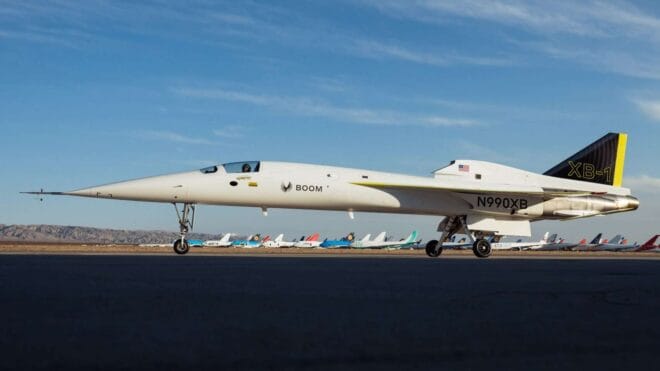
The Overture, a future civilian aircraft, recently broke the sound barrier in the United States, marking a significant milestone for the company planning to carry passengers in the coming years. When might we expect its first commercial flight?
A Historic Breakthrough in Civil Aviation
A groundbreaking event has captivated the aviation world: an American civilian aircraft has broken the sound barrier. This milestone, announced by Boom Supersonic on January 29, 2025, marks a historic turning point in the aerospace industry.
XB-1: The Precursor to Overture
The XB-1 aircraft, resembling a military fighter jet, is the first American-made civilian supersonic aircraft and the first to break the sound barrier since Concorde’s retirement in 2003. The Concorde, a joint venture of Air France and British Airways, operated for 27 years and remained the sole commercial supersonic aircraft until now. The XB-1’s flight took place at the site of Chuck Yeager’s first supersonic flight in 1947, making its mark in history.
Ambitious Project: Overture
The XB-1’s successful flight demonstrated that passenger supersonic flight technology is now achievable. According to Blake Scholl, founder and CEO of Boom, the next step is “to scale up the XB-1 technology for the commercial supersonic aircraft Overture.”
Overture is designed to carry 64 to 80 passengers at speeds up to Mach 1.7, doubling the speed of current commercial planes. It aims to connect over 600 routes globally, enabling flights such as Miami to London in under five hours.
An Environmentally Friendly Aircraft
Boom has secured 130 orders and pre-orders from American Airlines, United Airlines, and Japan Airlines for this new aircraft, which is set to fly entirely on non-fossil-based fuels. This makes it less polluting, less costly, and quieter than the Concorde due to its innovative engine design.
The company plans to begin operations by 2029. Its factory, completed in June 2024 in North Carolina, is expected to produce 33 Overture units annually. A second production site is planned to double this capacity.